
The issue of employee shirts fading after just a few washes often causes headaches for procurement teams and HR, as it makes the organization look unprofessional. As a professional employee uniform manufacturing factory, we take our customers deep into a real case study of an organization that ordered a large batch of shirts without thoroughly checking fabric color fastness, leading to severe color bleeding and premature fading.
Lessons from an Organization Experiencing Employee Shirt Color Bleeding
A logistics company ordered 1,000 field employee uniforms, focusing on dark shades to hide stains. However, because the buyer did not check fabric dyeing standards and chose a low-cost factory using low-grade dyes to reduce expenses, the result was severe color bleeding when employees washed them with other clothes. After only five washes, the uniform fabrics faded significantly, looking worn out with uneven color throughout. This forced the company to spend its budget on a complete reorder ahead of schedule.
Understanding Colorfastness: The Key to Choosing Uniform Fabric Colors
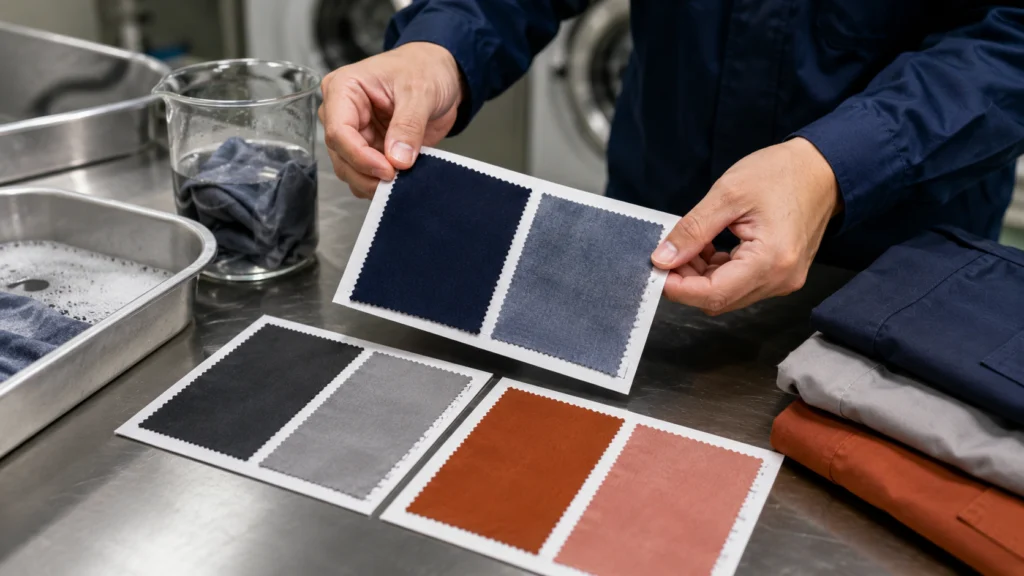
Colorfastness is the international standard criterion used by garment factories to test how much pigment on fibers will release when exposed to water, detergent, friction, and sunlight. When purchasing employee uniforms, procurement teams should request laboratory test reports. For heavy-duty use, the good standard criterion for washing fastness should be at level four or higher to ensure uniform fabrics do not fade too quickly.
Fabric Inspection Techniques and Choosing a Manufacturing Factory to Prevent Issues
Preventing problems at the source is the most cost-effective method for bulk custom orders. We recommend organizations request actual fabric samples for self-wash testing before signing production contracts. Additionally, consider fiber types and dyeing processes, as fabrics containing polyester fibers often retain color more durably than 100% natural cotton in certain dark shades, while also clearly inquiring about product warranty terms from the factory.
Summary of Guidelines for Choosing Uniform Fabric Colors for Long-Lasting Use
Understanding Colorfastness and inspecting uniform fabric color quality before mass production helps procurement teams and HR effectively control budgets, receive vibrant, durable employee uniforms, and enhance the organization’s long-term image without worrying about fabric fading or color bleeding issues anymore.