
When producing corporate workwear, procurement and human resources departments often face a critical question: should they use ready-made uniform fabrics, or invest in custom-weaving fabrics from scratch according to company specifications? As a uniform manufacturer, we provide these insights to help you make precise and budget-optimized decisions.
Structural and Weaving Differences Between Ready-Made and Custom-Woven Fabrics
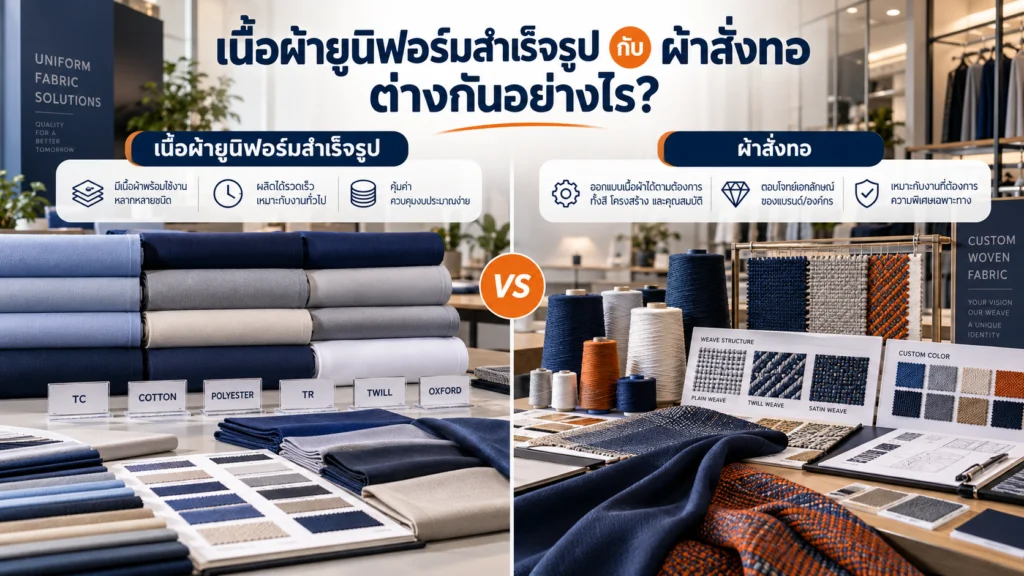
Standard ready-made uniform fabrics, such as Combed Twill or Toray uniform fabrics, are mass-produced in popular weaves like twill or herringbone. They offer fabric consistency due to large-scale industrial manufacturing. On the other hand, custom-woven fabrics involve a process where mills spin yarns to special blend ratios, such as polyester-cotton in specific proportions, to achieve the weight and hand-feel desired by the organization, though this comes with very high minimum order quantities.
Comparing Weight, Grammage, and Shrinkage Criteria in Practical Application
In textile engineering, fabric weight or GSM (grams per square meter) is an indicator of thickness and durability. Ready-made fabrics typically have a standard grammage of 200 to 250 GSM, which is suitable for general shirts and workshop jackets. Post-wash shrinkage rates for ready-made fabrics and premium custom-woven fabrics range around 2 to 3 percent, an acceptable industry standard. However, specialized custom-woven fabrics may require pre-testing for shrinkage if high proportions of natural raw materials are used in the blend.
Results from Repeated Laundering and Color Fastness
Testing color fastness to repeated washing is the heart of staff uniforms. Good grade ready-made fabrics go through reactive dyeing processes, making them reasonably resistant to industrial laundry detergents. Meanwhile, custom-woven fabrics allow color fastness criteria to be customized to higher levels based on on-site requirements, such as roles exposed to high heat or chemicals, which require specialized fibers and higher-cost dyeing processes.
Decision-Making Criteria for Procurement and HR Teams
Choosing between these two types primarily depends on the organization’s specific objectives. If speed, easy budget control, and relatively low employee headcounts are priorities, choosing ready-made uniform fabrics fits the need as they have stock ready for immediate cutting and sewing. However, if your organization has a unique brand color identity that cannot be matched in the market and requires a production volume of thousands of pieces and up, custom-weaving specialized fabrics will offer a better long-term investment return.
Precautions Regarding Production Lead Time and Minimum Order Quantities
An important factor procurement must consider is lead time and minimum order quantities for production. Ready-made fabrics generally have faster delivery times since they do not require waiting for new fabric weaving processes from upstream mills. Custom-woven fabrics add several weeks specifically for yarn preparation and weaving to meet the specified lot, which directly impacts the organization’s annual uniform distribution and requisition plan.
Summary of Fabric Selection Suited for Organizations
Choosing the right fabric for the type of work helps reduce frequent uniform replacement issues and efficiently controls organizational costs. Whether opting for standard ready-made fabrics or planning ad-hoc custom fabric weaving, key considerations should include the working environment, budget, and delivery timeline.